"I Am Woman — The Power is Within Me" — charity calendar for the year 2025. Join to our project!
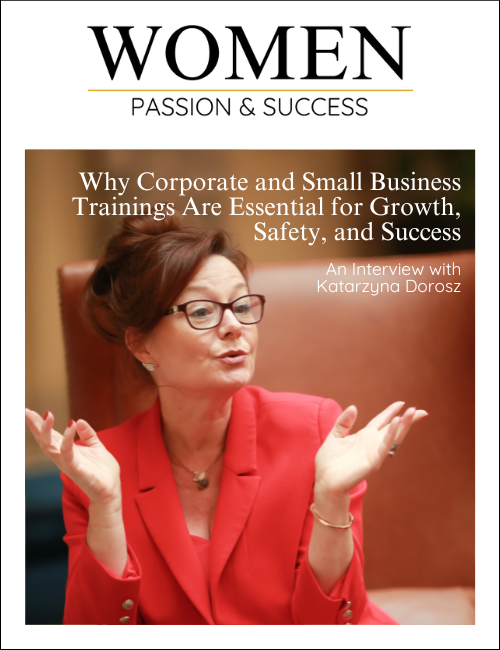
Interview with Katarzyna Dorosz
Journalist: Katarzyna, you have been conducting trainings for years and working with both large corporations and small businesses. Why do you believe investing in training is so important?
Katarzyna Dorosz: Training is the foundation of every organization. Whether we are talking about a global corporation or a small family-owned company – everything comes down to people. And people determine whether a business succeeds or fails. Training not only develops skills but also builds a culture of safety, collaboration, and responsibility. An employee who understands their role and has support in personal development works more effectively, makes fewer mistakes, and is more motivated.
Some say that training is just a “nice-to-have.” What does it really bring to a company?
KD: It’s absolutely not a luxury; it’s an investment that pays off. Training provides several key benefits:
- Prevention of mistakes and conflicts – employees learn how to react in difficult situations, communicate within the team, and solve problems.
- Building mental resilience – stress, pressure, and a fast-paced environment are daily realities. Training helps people manage them.
- Practical skill development – from customer service to leadership. This translates into measurable business results.
- Loyalty and reduced turnover – when employees feel that the company invests in their growth, they are far less likely to leave.
You mentioned prevention. Can training really help avoid tragedies in business?
KD: Yes, and that’s not an exaggeration. A tragedy in business doesn’t only mean physical accidents or PR crises. It can also be the loss of key employees due to burnout, lawsuits caused by poor communication or mishandling, or massive financial losses due to oversight. Training in safety, ethics, stress management, or leadership can prevent many of these situations. Imagine this: one unprepared manager can make a decision that costs the company millions. One untrained employee can mishandle a customer and ruin the brand’s reputation.
How do trainings differ between large corporations and small businesses?
KD: In corporations, there are complex structures, so trainings are often systemic – leadership programs, onboarding sessions, compliance training. In small businesses, sometimes a single well-chosen workshop on communication, motivation, or customer service can transform the entire workplace. Paradoxically, in smaller companies, the effects are visible faster because the training impacts the whole organization directly.
Can training become a tool for building competitive advantage?
KD: Absolutely. In the era of automation and artificial intelligence, the greatest advantage is people – their creativity, empathy, and teamwork. Training enhances these qualities. A company that invests in its people becomes an attractive employer and attracts top talent. And a team that is trained and motivated will always outperform a team that operates chaotically.
If you had to give one piece of advice to business owners, what would it be?
KD: Don’t wait until a crisis happens. Training is prevention. Just as regular health check-ups protect your body, training protects your business from mistakes, losses, and tragedies. It is the cheapest and most effective insurance for your company.